The Urge to Merge III
November 16, 2006 | Filed Under Law Firm Trends, In the News
Just when you want to call a time out on subject you get called for delay of game…
Law.com flagged the story that law firms Drinker Biddle and Gardner Carton will merge. Drinker Biddle gets naming rights, except in Big 10 country (Illinois and Wisconsin) for awhile. (One assumes the option of Carton Drinker did not make the second draft of the merger agreement.)
There must be something in the water that makes Philly firms have some form of brotherly love for Windy City firms, since Reed Smith announced in October that it was planning to merge with Sachnoff & Weaver.
Most of the typical rationales are offered in support of the Drinker-Gardner merger: new practice areas, new offices in more states, lack of client conflicts, similar comp systems.
But then this remark attributed to Gardner Vice Chairman Edwin A. Getz caught my eye:
He said Gardner Carton has traditionally been a “stand-alone” firm in which it looked to grow organically. About a year ago, he said, the firm began to look more seriously at other growth options.
The conclusion was that a merger with Drinker Biddle was the best choice, he said.
Merger = Growth?
In my book, no.
A law firm merger can lead to growth, but in the short term it likely leads to some retrenchment due to conflicts or partners who are now tempted to take a headhunter’s call.
And then there is the post-merger reality common in the corporate world, but rarely mentioned in the legal press: restructuring. To his credit, Drinker chairman Alfred Putnam acknowledges the elephant in the boardroom:
As the two firms continue the integration process over the next year and beyond, Putnam said it might become apparent that a reorganization of practice groups makes sense.
Bingo! Finally someone makes mention of something that hints at making operations more efficient. This could (gasp!) lead to more effective delivery of legal services to the new Drinker Biddle’s clients. Hewlett Packard, Comcast, General Electric, GlaxoSmithKline, Johnson & Johnson, JP Morgan, Wal-Mart, Illinois Tool Works and Motorola just might raise a glass to that.
Best of luck to all. Cheers!

Fax a Lawsuit, Roll Tide
November 14, 2006 | Filed Under Tactics, In the News
It’s college football week on The Wired GC. Let’s blow the whistle and kick things off.
First, a trip to the SEC. That’s this one, not that one.
Sometimes legal methods have to be reviewed as much as legal rights.
The New York Times featured a lead article over the weekend about the University of Alabama’s lawsuit against sport artist Daniel A. Moore. This picture, “The Sack,” depicts a famous hit on Notre Dame quarterback Steve Beuerlein by Alabama player Cornelius Bennett in 1986.
The university alleges that Mr. Moore’s paintings violate trademark rights, including the use of crimson and white (note: crimson is one thing, but when an artist can’t use white, hmmmm).
So far so good; a university needs to police and protect its marks.
But Alabama didn’t just talk about this with Mr. Moore, who has quite a following among ‘Bama faithful. In fact, Mr. Moore is an Alabama alum, painting football memories for decades. He has two daughters attending the university, and one who has graduated.
No, according to the Times they called a “Konica Flare on 3,” which is also known as serving lawsuit papers by fax. This always looks bad when recounted in the press. It helped earn this sort of response by one of ‘Bama’s own:
“This lawsuit is the equivalent of the Catholic Church suing Michelangelo for painting the Sistine Chapel,” said Keith Dunnavant, an Alabama alumnus and the author of “Coach: The Life of Paul ‘Bear’ Bryant.”
The Times notes that the university declined requests for interviews, supposedly on “advice of counsel.” Perhaps they should have consulted a certain emeritus faculty member first on how to review options before running with a lawsuit:
James Glen Stovall, who taught journalism at the university for 25 years, said only one sort of person would support the suit. “I can see why, if you’re sitting in a roomful of lawyers, you might come to that conclusion,” Mr. Stovall said. “But no one outside of that room would say: ‘Hey, that’s a good idea. Let’s sue Daniel Moore.’ ”
Ouch.
And in Professor Stovall’s remarks, there are at least three insights for GCs. The first is just because you can, doesn’t mean you should. The second is that methods matter, and are largely what the court of public opinion rules on. Finally, there’s the reality of the “no comment” in the Internet Age. If you want spokespeople to try that handoff to “the lawyers,” fine. Just don’t be surprised when your little lawsuit shows up on page one of a major newspaper, and on its website.
It’s the kind of PR a university just can’t buy.
And surely this lawsuit would find its way into the Alabama student newspaper and student life. (They can only write so many articles about dorm food and freeing Tibet). There has been a petition circulated on campus supporting Mr. Moore that has garnered over 2,000 signatures. (The student writer actually does a great job of digging into the story; showing it has shades of grey in addition to crimson and white).
Now if that grey was in paintings involving the Ohio State Buckeyes, all bets are off. (Does it go with scarlet or clarett?)
Mr. Patrick Goes to Boston
November 8, 2006 | Filed Under GC as CEO Springboard, In the News
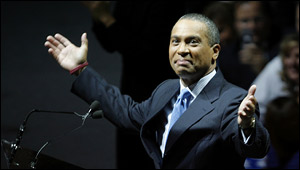
Congratulations to Deval Patrick this morning. He was elected governor of Massachusetts by a resounding 56% of the vote.
Mr. Patrick is a former GC of Coca-Cola, and was also the Assistant AG for Civil Rights under President Clinton. He began the race to the statehouse early last year, facing long odds and a much better known opponent (the Lt. Governor). His impressive bio is here.
From Mr. Patrick’s acceptance speech:
You see in common how broken our civic life and how fractured our communities are. You see in common that the poor are in terrible shape and the middle class are one month away from being poor. And you know that government by gimmick and sound bite isn’t working. You know that we deserve better and we are better than that. And for a chance at a better and more hopeful future, you built bridges some of you never thought could be built across all kinds of differences — and then you crossed them.

The Client Speaks — Wilbur Ross
November 7, 2006 | Filed Under The Client Speaks
A new feature today; from the mouths of clients oft time come gems.
Appearing in a New York Times article about the merger integration of steelmakers Mittal and Arcelor:
“Any management designed by lawyers is much more complicated than it needs to be.”
— financier and Mittal board member Wilbur L. Ross.
The GCs Strike Back
November 3, 2006 | Filed Under Law Firm Trends, Legal Resources
Amid the talk of law firm mergers, it’s interesting to see what some clients are thinking.
It’s not about big platforms and ever bigger profits per partner.
An article in The Lawyer from the UK related a survey of in-house counsel by Grant Thornton about their views of law firms, particularly in the area of dispute avoidance. The results would make any managing partner squirm a bit.
The majority of inside counsel respondents wanted to spend more on dispute avoidance, and nearly 90% reported strong board support for doing so.
So this would be a source of new business for alternative dispute resolution practice groups?
Not so fast.
The respondents laid the wood on that idea a bit:
However the survey also found in-house counsel were reluctant to involve private practice firms in dispute avoidance, citing high fees, lack of business understanding, and a “litigious mindset”.
Ouch!
Note what is going on here: firms see things like ADR as a new source of business. But clients don’t just want to resolve disputes better.
They want to avoid disputes in the first place. And they don’t think their outside counsel “get it.”
If that wasn’t enough, Grant Thornton partner Toni Pincott closes the article by returning to a favorite theme haunting law firms:
“They also need to rethink how they charge for these services - this is an area where hourly rates will just not be acceptable.”